
A Singaporean's Guide to Buying Property in Vietnam (2026): Rules, Risks & Realities | Zac Chen
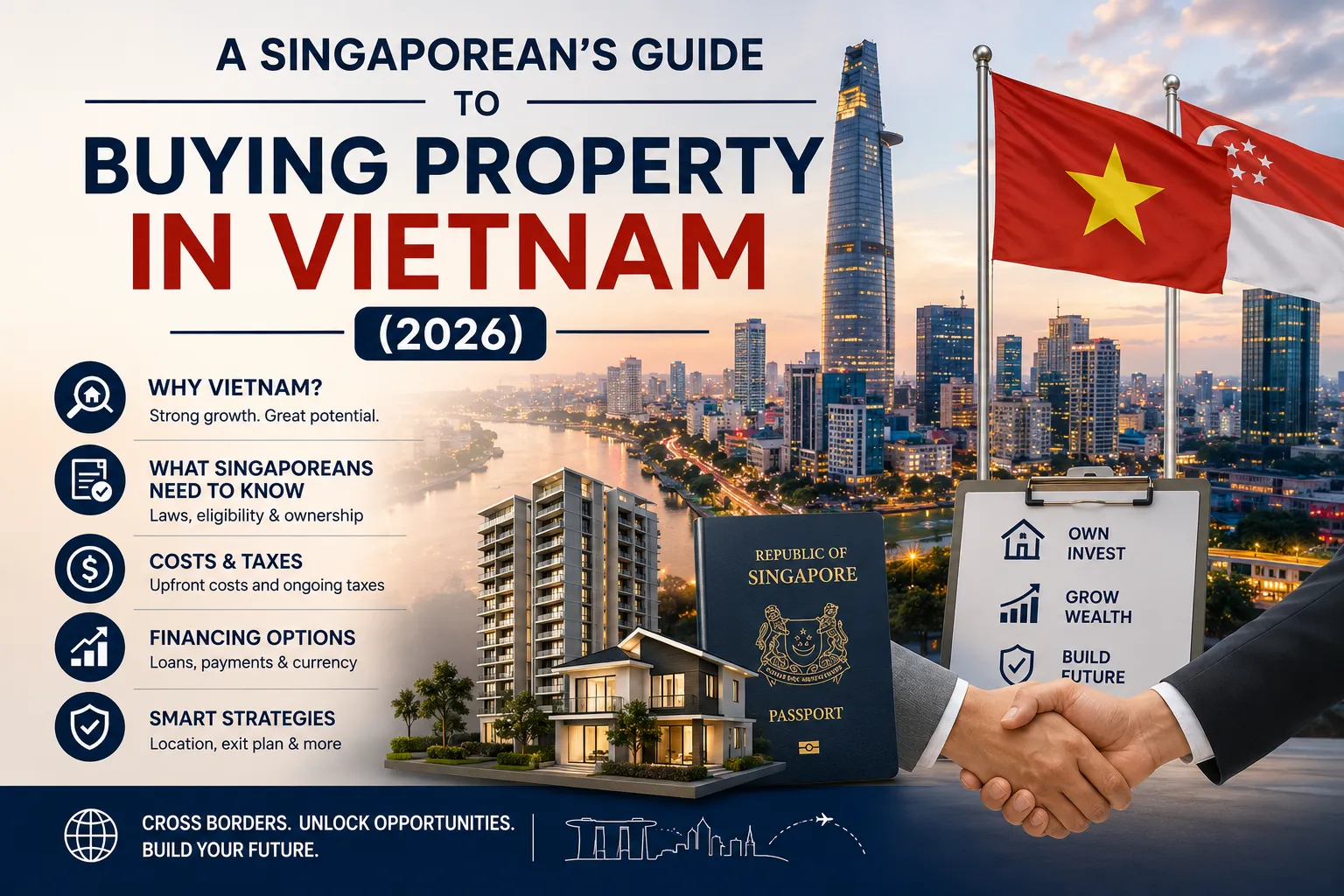
A
Singaporean's Guide to Buying Property in Vietnam (2026)
Vietnam has become one of the
most-watched property markets in the region for Singapore-based investors —
fast-growing cities, rising rents, and prices still far below Singapore's. But
the rules for foreign buyers are specific, and they were substantially
rewritten in 2024. Here's what a Singaporean needs to understand before looking
seriously.
The
legal reset: Housing Law 2023 and Land Law 2024
Vietnam's foreign-ownership
framework now runs on the Housing Law 2023 and the Land Law 2024,
which came into force on 1 August 2024, together with the Real Estate Business
Law. They kept the core restrictions but clarified the rules and, importantly,
improved a foreign owner's ability to exit.
What
you can — and can't — buy
●
You can own apartments, and some landed
houses/villas, but only within commercial housing projects licensed for
foreign ownership.
●
You cannot own land. Land-use rights are
reserved for the State and Vietnamese citizens; a foreigner owns the building/dwelling,
not the ground beneath it. Raw land is off-limits.
●
You cannot buy in areas designated as sensitive
for national defence or security.
How
long you own it: the 50-year leasehold
Foreign ownership runs as a 50-year
leasehold, renewable once for another 50 years (up to 100 years total). The
clock starts on the date your ownership certificate — the “Pink Book” — is
issued. One notable exception: a foreigner married to a Vietnamese citizen
can hold on stable, long-term (freehold-style) terms like a local.
The
quota: 30% per building
To protect local housing supply,
foreigners can collectively own no more than 30% of the units in any single
apartment building or block, and no more than 250 landed houses per
ward-equivalent area (some projects also cap landed homes at around 10%).
Once a building hits its foreign quota, foreigners can only buy from other
foreigners. Desirable projects fill their foreign allocation quickly — so verify
a specific unit's quota status in writing before you put down any deposit.
The
big 2024 improvement: you can now sell to other foreigners
Under the old regime, foreigners
could largely only sell back to Vietnamese buyers, which badly hurt resale
liquidity. The Housing Law 2023 now permits foreigner-to-foreigner resale
— a meaningful improvement to your exit options, though the buyer still has to
fit within that building's 30% quota.
The
money side
●
Mostly cash. Local mortgages are generally not
available to foreign buyers, so most pay cash.
●
Budget beyond the price. Expect VAT (around 10%
on new units from a developer), a registration fee, a maintenance/sinking-fund
contribution (commonly around 2%), plus notary and legal costs — the extras can
add materially to the sticker price.
●
Rental income is taxable in Vietnam, and a sale
attracts transfer tax. Get local tax advice on the current rates.
●
Repatriation. You can generally take sale
proceeds and rental income abroad — but only if your money came in through documented
banking channels. Keep every remittance record from the start.
Two
things Singaporeans often assume wrongly
●
Buying does not grant a visa or residency. You
must have legally entered Vietnam to buy, but ownership confers no immigration
status.
●
Ownership is not the land. You're buying a
time-bound right to the dwelling, not the freehold land — factor the remaining
lease term into both your return and any inheritance planning, especially on
resale units.
Due
diligence checklist
●
Confirm the project is licensed for foreign ownership
and the specific unit is within the 30% quota — in writing.
●
Do proper developer due diligence; Pink Book issuance
can be slow and is developer-dependent.
●
On a resale, check the remaining lease term, not just
the price.
●
Engage qualified, independent Vietnamese legal counsel
— do not rely on the developer's paperwork alone.
Frequently
asked questions
Can a Singaporean own property in Vietnam outright?
You can own the apartment or
house within a licensed project, but on a 50-year renewable leasehold — not the
land, which stays under State/citizen ownership. The exception is marriage to a
Vietnamese citizen, which allows local-style long-term ownership.
Can I get a loan in Vietnam as a foreigner?
Generally no — local mortgage
financing is largely unavailable to foreign buyers, so most purchases are cash.
Can I sell and bring the money back to Singapore?
Yes, provided your original
funds entered Vietnam through documented banking channels. Keep all remittance
records, as they're needed to repatriate proceeds later.
Does buying property get me residency in Vietnam?
No. Property ownership grants no
visa or residency; it's an investment and lifestyle asset, not an immigration
route.
Exploring Vietnam as an
investment? Through my consultancy I help Singapore-based buyers weigh the
market, the quota and the exit realities — and connect you with qualified local
legal counsel before you commit. [Book a consultation.]
This guide is general information for Singapore-based readers, reflecting Vietnam's Housing Law 2023 and Land Law 2024 as of July 2026. Vietnamese property law is complex and evolving — it is not legal, tax or financial advice. Always engage licensed Vietnamese legal and tax advisers for any specific transaction. Zac Chen Consultancy Pte. Ltd.

Author : Zac Chen
Date : 2026-08-17 10:49:23
Unlock Full Details & Take the Next Step
At Zac Chen, we're here to help you every step of the way. Whether you're buying, selling, or investing, our expert agents are ready to provide personalized guidance and support. Don't wait—take the first step towards your real estate goals today.