
Property Decoupling in Singapore 2026: When It Works and the ABSD Math | Zac Chen
Property
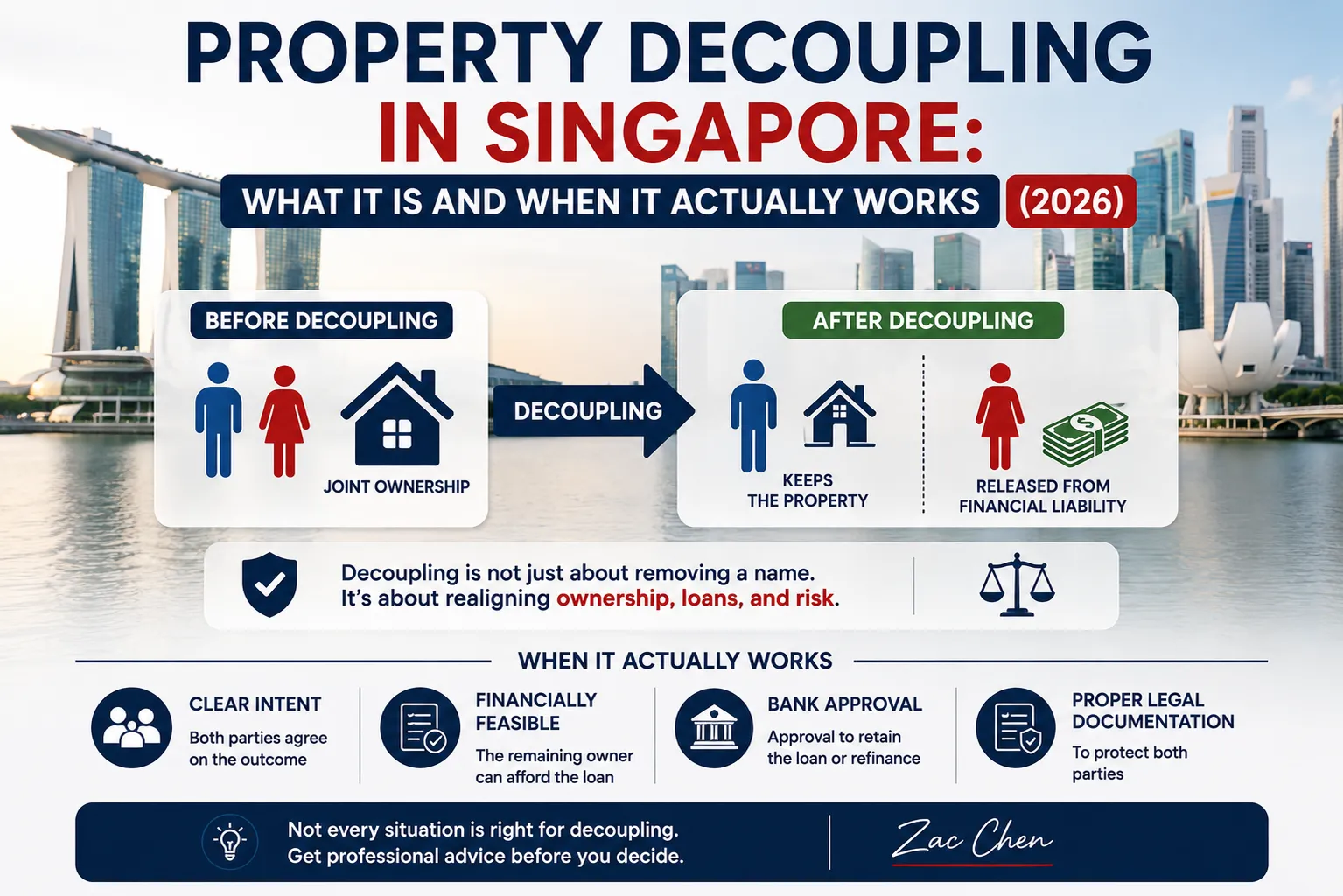
Decoupling in Singapore: What It Is and When It Actually Works (2026)
With ABSD at 20% for a Singapore
Citizen's second property, couples increasingly ask whether “decoupling” can
help them own a second home without the surcharge. Sometimes it can — but only
for the right property type, and only when the savings genuinely outweigh the
costs. Here's how it works in 2026, and where it doesn't.
What
decoupling is
Decoupling (formally a part-sale
or part-purchase) is where one co-owner buys out the other's share of a jointly
owned property at market value. Once done, one spouse becomes the sole owner,
and the other spouse no longer owns any property — freeing them to buy a second
home as a “first-timer” and, in principle, avoid the 20% ABSD on that purchase.
HDB
flats: decoupling is not an option
This is the first thing to get
straight. HDB closed the decoupling route in May 2016. Ordinary married
couples can no longer transfer one owner's share of an HDB flat to the other to
enable a second purchase. HDB ownership transfers between spouses are now
allowed only in specific circumstances — such as divorce or annulment, death of
a co-owner, or other court-ordered or hardship situations.
So decoupling in practice is a private-property
strategy (and, for Executive Condominiums, only after the 5-year MOP —
during the MOP an EC follows HDB rules and cannot be decoupled).
The
costs that eat into the saving
Decoupling is not free. Before
assuming it pays off, count all of this:
●
BSD on the transferred share. The buying-over
spouse pays Buyer's Stamp Duty on the market value of the share they acquire.
●
ABSD on the share, if applicable. If the
buying-over spouse already owns other property, ABSD can apply to the
transferred share based on their profile.
●
CPF refund with accrued interest. The exiting
spouse must refund any CPF used for the property, plus accrued interest, to
their CPF account — which reduces the cash actually freed up.
●
Legal fees for both parties. Each spouse needs
separate legal representation for the transfer.
●
Loan restructuring. Any existing mortgage must
be re-taken in the sole owner's name — and that owner must pass TDSR on their
income alone. If they can't, the plan stalls.
●
Possible SSD. If the property is still within
the Seller's Stamp Duty holding period (extended to 4 years in July 2025), SSD
may be triggered on the transferred share.
A
simplified worked example
Say a married couple (both SC)
jointly own a private condo worth S$2,000,000 (50/50), fully paid, and want to
buy a S$1,500,000 investment property:
●
One spouse buys the other's 50% share (worth
S$1,000,000). BSD on S$1,000,000 is about S$24,600. As they end up
owning just this one property, no ABSD applies to the transfer.
●
The exiting spouse, now property-free, buys the
S$1,500,000 second home as their only property — 0% ABSD instead of 20%,
a saving of S$300,000.
Here the ABSD saving dwarfs the
BSD and legal costs, so decoupling makes sense. But shift the numbers — a
cheaper second property, a large CPF accrued-interest refund, or an outstanding
loan the sole owner can't carry alone — and the case can collapse. Always run
the specific math first. For the ABSD side, see “ABSD Singapore 2026” in this
cluster; for the borrowing test, see the TDSR/MSR guide.
Do
it properly — or not at all
Decoupling is legal when it
reflects a genuine change of ownership with all duties correctly paid.
What is not legal is a contrived arrangement designed only to sidestep tax.
IRAS has actively audited artificial “99-1” and similar schemes, and
deliberately concealing a retained interest to avoid ABSD can amount to tax
evasion. Treat decoupling as a documented legal transaction with a conveyancing
lawyer, not a loophole.
The
simpler alternative: buy in one name from the start
If a second property is likely
on your horizon, the cleanest route is often to buy your first private property
in a single name from the outset — leaving the other spouse
property-free without any future restructuring cost. The trade-off is
protection: the non-owning spouse has no legal share in that property, so
couples should weigh this against the ABSD flexibility it preserves.
Frequently
asked questions
Can I decouple my HDB flat to buy a condo?
No. HDB decoupling for this
purpose was removed in May 2016. Transfers between spouses are allowed only in
limited situations such as divorce or death. If you own an HDB flat and want a
second property, the usual routes are selling first, or paying ABSD (and, for
upgraders, the married-couple remission).
Is decoupling legal?
Yes, for private property, when
it's a genuine transfer with all stamp duties paid. It becomes illegal only
when structured purely to conceal ownership and dodge tax.
How long does decoupling take?
Typically around 2–3 months
where there's an existing or new loan to arrange, since the mortgage must be
restructured under the sole owner.
When is decoupling worth it?
Only when the ABSD you'd save
clearly exceeds the total costs — BSD on the transferred share, legal fees, CPF
accrued-interest refund, and any SSD. It's a numbers exercise, not a default
move.
Decoupling only pays off on
the right numbers. I work alongside your conveyancing lawyer to model the ABSD
saved against every cost before you commit either way. [Book a consultation.]
This guide reflects IRAS and HDB rules as of July 2026 and is
general information, not tax or legal advice. Decoupling has significant legal
and financial consequences — engage a conveyancing lawyer and confirm current
rules with IRAS before acting. Zac Chen, ERA Realty Network Pte Ltd, CEA Reg.
R069804F.

Author : Zac Chen
Date : 2026-08-17 10:40:51
Unlock Full Details & Take the Next Step
At Zac Chen, we're here to help you every step of the way. Whether you're buying, selling, or investing, our expert agents are ready to provide personalized guidance and support. Don't wait—take the first step towards your real estate goals today.