
Navigating Property Investment in a Changing Economic Landscape
overseas property investmentmanaging riskadditional buyer stamp dutyvietnam real estate investmentthailand real estate investment
Navigating Property Investment in a Changing Economic Landscape
Navigating Property Investment in a Changing Economic Landscape
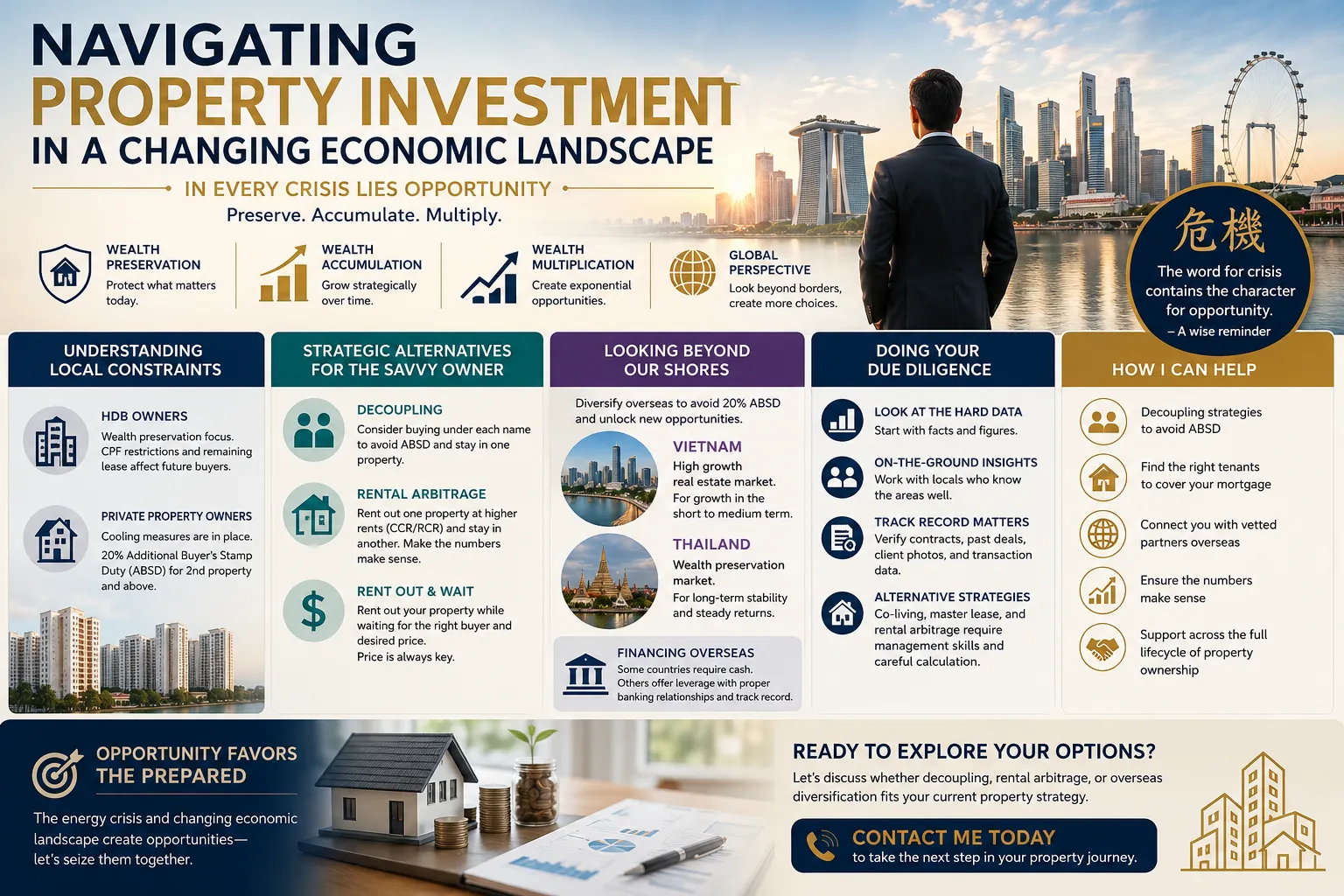
Today, as we navigate through May and look at the macroeconomic conditions globally, one phrase dominates the conversation: the energy crisis. But as a wise colleague recently shared with me, in Mandarin, the word for crisis contains the character for opportunity. Only in crisis do you have the chance to grow your wealth, accumulate wealth, preserve your wealth, or even multiply your wealth.
As property owners in Singapore, you face a unique landscape. You may have bought your property for own stay, intending to sell it later at a higher price and upgrade to a bigger place, or perhaps you're planning to downgrade to a smaller property as you gradually become empty nesters. Others among you are investors who have bought multiple properties over time, though those recent purchases likely incurred larger amounts of Additional Buyer's Stamp Duty—a cooling measure the government put in place as property prices were rising too quickly.
Understanding the Local Constraints
In Singapore, we have managed to separate speculation from affordable housing in our government policies. For HDB owners, your flat will probably function more as wealth preservation because even with price increases, they are just barely keeping up with inflation. You also face the CPF restriction track whereby your future buyers are restricted by the amount of CPF they can use depending on the balance lease left.
With private property, the government is also not going to allow prices to increase too rapidly. There are cooling measures in place, and there are clear indications that private property actually affects HDB prices as well. Right now, if you want to buy one property to stay in and buy another one, you're subjected to the Additional Buyer's Stamp Duty of 20% for Singaporeans.
Strategic Alternatives for the Savvy Owner
So what are your alternatives? If you are a married couple, you can consider decoupling so that you can buy one under each name, and you can stay in one of the properties. This was quite popular back then when couples bought together under both names, joint tenancy or tenancy in common, and then rented another property for themselves to stay in while renting out the property they bought. They used this rental arbitrage to make a profit because the property they bought could be rented out at a higher price—perhaps a larger property or one in a prime location like the Core Central Region or the Rest of Central Region—while they stayed in the outside core region. Of course, the numbers have to make sense before you do that.
For those of you who want to sell your property at a much higher price than what the market can accept, you may find that you are still paying the mortgage while waiting for the right buyer. In these situations, you might approach me to rent out your property first. Some owners need persuading to rent out their property first while waiting for the right buyer, though renting out may mean it is slightly more challenging to sell later, and again, it is about price. Some buyers will demand a slightly lower price for a rental property compared to a brand new unit, albeit all other factors being equal.
Looking Beyond Our Shores
If you still want to invest in property but want to avoid the 20% ABSD, you can invest in overseas property. However, what I have learned is that there are some countries where you'll not be able to take a bank loan, requiring you to pay cash in full. There are countries where you can use leverage where the bank is willing to lend you money, though you may need to have a privileged banking account—holding at least $100,000 to $300,000 inside the bank account before they will contact their counterparts where the overseas property is located to get you a bank loan.
When evaluating overseas markets, I recommend looking at Vietnam and Thailand as case studies. Vietnam is like a high growth real estate market, whereas Thailand will be more for wealth preservation. For high growth in the short to medium term, you'd pick Vietnam, but if you're thinking longer term and want stability, you'd pick Thailand.
Doing Your Due Diligence
When investing overseas, many worry that it is dangerous because it's far away, and you won't be able to keep an eye on it. But there are several ways to manage that. You should look at the hard data first and then validate it with on-the-ground insights. You need a local who actually knows the specific areas, especially somebody from the real estate industry. These people will need to show track record of contracts that they have done and successful deals that they have closed. A picture shows a thousand words—perhaps photos taken with previous clients and also the amount of money that they made based on the transaction data.
There are also other ways to use less cash but require hard work. On the extreme end, you have the co-living operators who take the master tenancy, master lease, and then sublet it out to several tenants to make that rent arbitrage. Of course, the expenses include cleaning of the common areas, and a lot of property management skills will have to come in. You have to manage the tenants as well and take the full risk of the property being vacant in between tenancies. You need to make your calculations first.
How I Can Help
Whether you are looking to decouple to avoid ABSD, need to rent out your property while waiting for the right buyer at your desired price, or are looking to diversify into high-growth markets like Vietnam or wealth-preservation markets like Thailand, navigating these decisions requires precise planning.
I can help you make the numbers make sense. From finding the right tenants to cover your mortgage while you wait for the perfect sale price, to connecting you with vetted partners in overseas markets who have the track record and transaction data to back their claims, my services cover the full lifecycle of property ownership.
The energy crisis and changing economic landscape have created opportunities—but only for those with the right guidance to seize them. Let's discuss how to position your property portfolio for wealth preservation, accumulation, or multiplication in these interesting times.
Ready to explore your options? Contact me today to discuss whether decoupling, rental arbitrage, or overseas diversification fits your current property strategy.

Author : Zac Chen
Date : 2026-05-27 07:17:50
Unlock Full Details & Take the Next Step
At Zac Chen, we're here to help you every step of the way. Whether you're buying, selling, or investing, our expert agents are ready to provide personalized guidance and support. Don't wait—take the first step towards your real estate goals today.