
Property Strategy Under Singapore's Cooling Measures (2026): Your Options | Zac Chen
Property
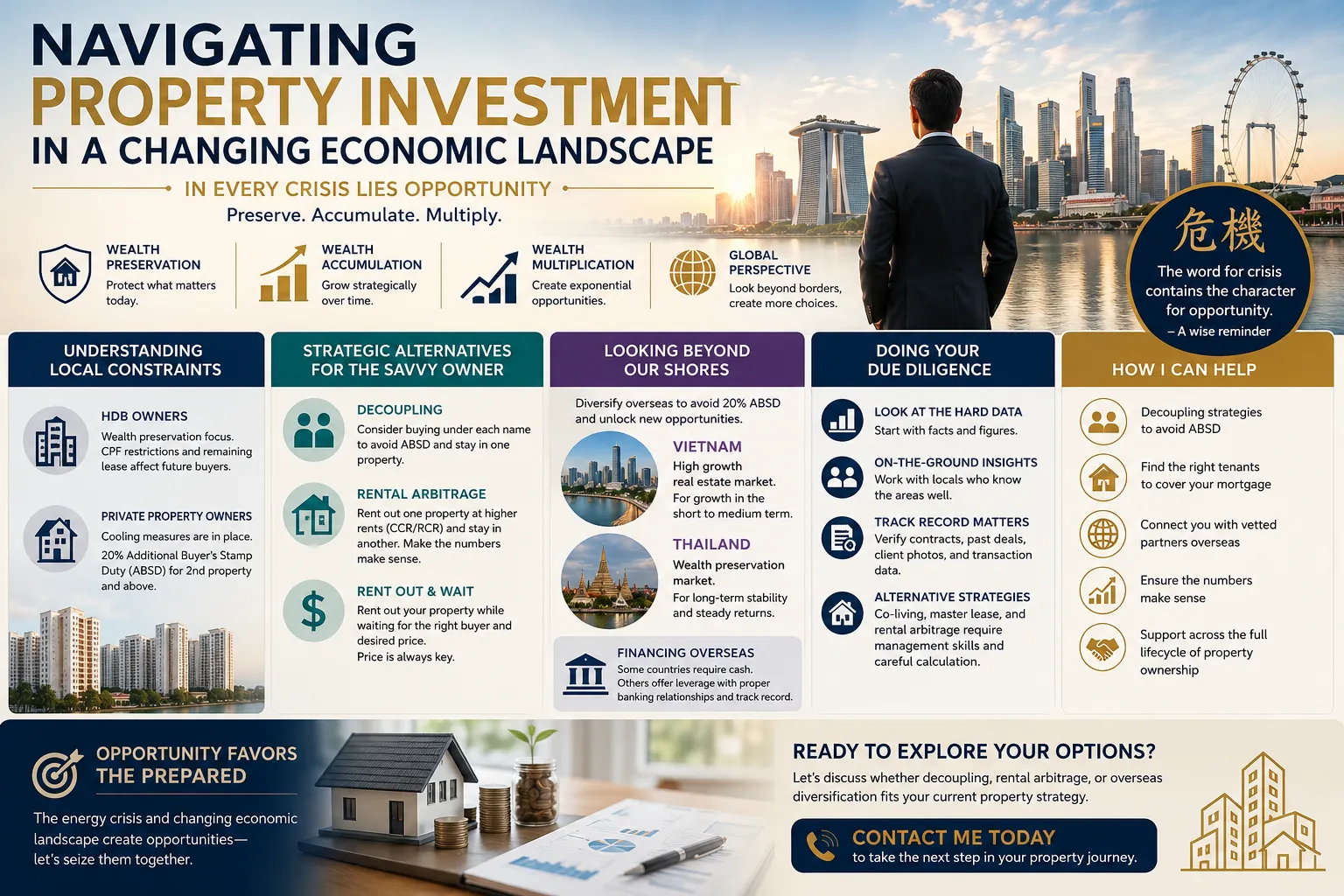
Strategy Under Singapore's Cooling Measures: Your Options (2026)
Cooling measures have reshaped
how Singaporeans build a property portfolio. With 20% ABSD on a citizen's
second home, the old “just buy another one” playbook no longer works by
default. But owners still have real options — it comes down to making the numbers
work. Here's a plain-English menu of the main routes and where each fits.
The
backdrop: ABSD is the constraint to plan around
Any strategy for a second
property starts with ABSD: 20% for a Singapore Citizen's second home, 30% for a
third. That single figure decides whether a move makes sense, so model it first
— see “ABSD Singapore 2026” in this cluster for the full rate table and the
remissions that can reduce it.
Option
1: Decouple (private property only)
If you're a married couple who
jointly own a private property, one spouse can buy out the other's share
so the freed-up spouse can buy the next home as a “first-timer” and avoid the
20% ABSD. Two caveats matter: HDB decoupling has been banned since 2016,
so this is a private-property route only; and it carries real costs (BSD on the
transferred share, legal fees, CPF refunds) that must be smaller than the ABSD
saved. The full breakdown is in “Property Decoupling in Singapore” in this
cluster.
Option
2: Rent while you wait for the right price
If you want to sell but the
market isn't yet offering your price, one option is to rent the unit out first
— covering the mortgage while you wait — rather than accepting a lowball offer.
The trade-off: a tenanted unit can be marginally harder to sell and some buyers
expect a small discount versus a vacant, move-in-ready home. As always, it
comes down to price and timing. Registering your Intent to Sell early keeps you
ready to move the moment the right buyer appears — see “HDB Intent to Sell” in
this cluster.
Option
3: Diversify overseas to sidestep ABSD
Some investors look abroad
specifically to deploy capital without paying 20% ABSD at home. Financing
differs sharply by market: several markets are effectively cash-only for
foreigners, while others may offer leverage — sometimes only through an
international or priority-banking relationship. As a broad positioning, Vietnam
is often viewed as a higher-growth play for the short-to-medium term,
while Thailand is more of a wealth-preservation market for the longer
term. Each country has its own foreign-ownership rules, so treat these as
starting points, not conclusions. For a detailed, verified example, see “A
Singaporean's Guide to Buying Property in Vietnam” in this cluster.
Doing
your due diligence overseas
The distance worry is manageable
if you work in the right order: start with the hard data (prices, yields,
supply, the legal framework), then validate it with a credible local — ideally
someone in the industry who can show a real track record: closed deals,
contracts and transaction figures, not just glossy brochures. And engage
independent local legal and tax counsel before committing a cent; never rely on
a developer's paperwork alone.
A
forward-planning note
If a second property is on your
horizon, the cleanest move is sometimes made years earlier: buying your first
private home in a single name preserves the other spouse's “first-timer” status
without any future decoupling cost. The trade-off is legal protection for the
non-owning spouse — a decision to make deliberately, not by accident.
Frequently
asked questions
Can I avoid ABSD by decoupling my HDB flat?
No — HDB decoupling for this
purpose was removed in 2016. Decoupling is a private-property route only. For
an HDB flat, the usual options are selling first or using the married-couple
ABSD remission when upgrading.
Is buying overseas a way around ABSD?
Overseas property isn't subject
to Singapore ABSD, so some investors diversify abroad. But you take on
different risks — financing limits, foreign-ownership rules, currency and
distance — so it needs its own due diligence and local advice.
Should I rent out my property or sell it now?
It depends on your holding cost,
the current market and your target price. Renting can bridge you to a better
sale, but weigh the slightly softer resale appeal of a tenanted unit. It's a
numbers decision.
Every one of these routes
lives or dies on the numbers. Whether it's decoupling, renting while you wait,
or diversifying abroad, I'll help you pressure-test the maths and connect you
with vetted partners. [Book a consultation.]

Author : Zac Chen
Date : 2026-05-27 07:17:50
Unlock Full Details & Take the Next Step
Ask Zac your first question. Whether you're buying, selling, or just figuring out if now's the right time, you'll get a real answer, not a sales pitch.